


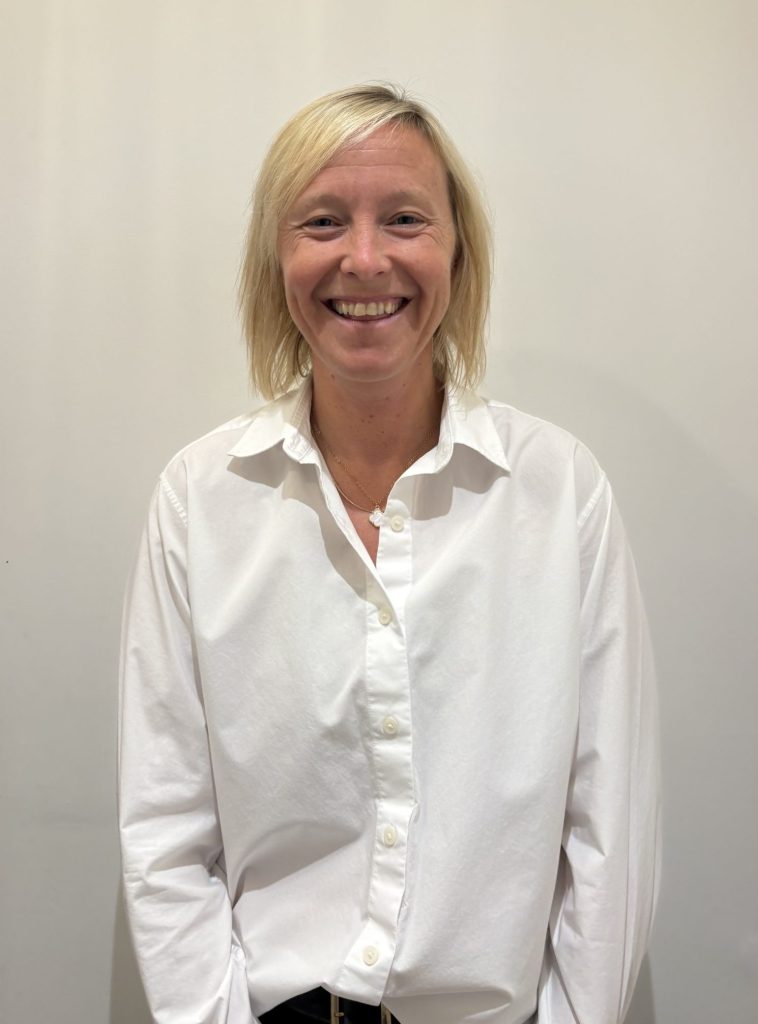
“I’ve learned more in nine months than in my whole career”
Bex Fox, development practitioner and soon-to-be deputy headteacher, on what changed when Emmaus arrived, and why, after thirteen years in teaching, she feels as though she is only just getting started.
Bex Fox has been teaching for thirteen years, most of them at St Edmund’s in Monsall, where she became a Year 6 teacher and English lead and, by her own account, knew the place inside out. She is also a working mum, and she has built all of this while keeping the work-life balance her family needs.
On paper, she is exactly the kind of experienced teacher who might have quietly settled into a system that worked. Instead, in a single year, she has led a Emmaus-wide development board, worked alongside professors and chief executives in national research, and is soon to step into a deputy headteacher role. Ask her what changed, and she points straight to Emmaus.
When St Edmund’s joined Emmaus, Bex was invited to apply for a newly created role: development practitioner, leading Emmaus’s Pedagogy Development Board. It brings teachers and central-team colleagues together from across Emmaus to work out, in practical terms, what great teaching actually looks like, testing ideas in real classrooms and then comparing notes.
What struck her most was the culture. “There’s no judgement there at all,” she says. “Nobody turns up with their books saying ‘look how great I am.’” In a profession where staff often guard their work closely, that openness has changed how she teaches.
Within weeks of moving to St Malachy’s in Manchester as a Year 4 teacher, she had dropped a word from the way she described herself. “I was saying ‘I’m just a class teacher,’ and then I removed that word ‘just.’”
The role opened doors she hadn’t expected. Through Emmaus she joined Emmaus’s lab schools work, a strand of research-informed practice led by a leading education professor. It took her into instructional rounds and high-level discussion alongside headteachers, chief executives and university academics. “That blew my mind,” she says. “A mere class teacher, going in and having those conversations.” A recent national writing event, run with the PTI (a professional development charity for teachers), sent her back to school with so much that a colleague was using it the next morning.
None of it, she says, is box-ticking. “It’s so purposeful. It’s not a course where you go away and think, now what was the impact of that?” If anything has needed working out, it is simply how to fit the meetings around busy school calendars. They already sit within the school day, and the board is now trialling some of them online so colleagues can join without the travel time.
Underpinning all of it is the approach Emmaus describes as walking alongside rather than directing from above. For Bex that has had a name: Jo Lindon, who leads professional development across Emmaus and has mentored her from her first interview onwards. “She’s my line manager,” Bex says, “but when we’re in the board together it’s so level. She lets me lead. At no point is it ‘I’m here from Emmaus, this is my role.’” Even now the board is established and nominally hers, Jo develops the work with her, not for her. “It feels like you’ve got a team,” she says. “It’s not just on you.”
Meetings begin with a reminder of why everyone is there. As a Catholic values organisation, Emmaus puts care for the whole person at the centre, and Bex, who has spent her career in Catholic schools, feels it in the everyday.
For a working mum building a serious leadership career, the obvious question is what all of this costs at home. Her answer is one she expects people to find hard to believe: very little. CPD happens in school time, not bolted on to the end of an exhausting day. “There’s no late-night email,” she says. “Everything is well planned.”
Taking on the board barely added to her workload, and if anything it gave her energy. “I don’t feel overworked or overtired. I’m just thinking, how can I get this into action?” She has never had to ask for flexibility around family life, but is confident the answer would be yes, having watched colleagues experience exactly that when they have needed time for their own children.
In September she moves to St Mary’s in Stockport, which is in the process of joining Emmaus, as deputy headteacher. It is a twelve-month secondment, with the door deliberately left open for her to return. Nobody pushed her towards it. “Nobody put pressure on me to apply,” she says. “There was no ‘this is your next move.’” Emmaus simply gave her enough exposure to leadership, research and colleagues across schools that the ambition grew on its own.
What is she proudest of? Not the promotion, but the board: “how successful we’ve all been this year, introducing something, trialling it in our own classrooms, and seeing a real impact on the pupils.” That, she points out, is exactly what Emmaus means when it says that investing in staff is how pupils flourish.
What the year has really done is reignite a teacher who, after thirteen years, might reasonably have thought she had seen it all. As Bex puts it, “I wasn’t miserable. I just didn’t know that I could do it even more.” Her message to anyone weighing up Emmaus, especially those who are ambitious but also juggling family life, is a simple one. “Just go and try it. It’s impossible to go to one of the meetings and not learn something useful, so why would you not?”